
Some natural places can absorb thousands of visitors with relatively little lasting damage. Others can be harmed by a few careless footsteps.
Alpine meadows, desert biological soil crusts, nesting beaches, wetlands, coral environments, fragile dunes, and remote islands often recover slowly once disturbed.
That is why advanced conservation travel strategies for sensitive ecosystems go beyond simply carrying out your trash. Responsible travel requires understanding how visitors affect soil, vegetation, wildlife movement, water quality, and even the spread of invasive species.
Leave No Trace notes that repeated trampling can damage vegetation and create unwanted trails, while particularly fragile surfaces such as living desert soil can be damaged by a single footstep.
The goal is not to avoid sensitive landscapes entirely. Well-managed tourism can support conservation, education, and local communities.
The smarter approach is to travel in ways that match the ecological limits of each destination, allowing people to experience remarkable places without gradually degrading the reasons they came.
1. Research Ecological Sensitivity Before Choosing the Route
A good conservation trip starts before the first step on the trail.
Instead of choosing a route only because it reaches the most dramatic viewpoint, research which habitats are most vulnerable. Wetlands, nesting beaches, alpine vegetation, desert crusts, and riparian zones can respond very differently to visitor pressure.
Seasonal access rules matter as well. The U.S. Fish & Wildlife Service notes that parts of wildlife refuges may be closed seasonally or permanently to reduce disturbance to sensitive species and habitats.
At Guadalupe-Nipomo Dunes National Wildlife Refuge, for example, beach access is closed during part of the year to protect nesting habitat for the threatened western snowy plover.
Treat closures as ecological information, not an inconvenience.
If one route is restricted, select an authorized alternative instead of looking for an unofficial way around it.
2. Concentrate Travel on Durable Surfaces
Where you place your feet can matter more than how far you travel.
Leave No Trace defines durable surfaces as places such as established trails, rock, gravel, sand, dry grasses, and some snow-covered terrain. Concentrating travel on these surfaces can reduce damage to vegetation and help prevent multiple informal trails from developing.
In popular areas, stay in the middle of established trails even when they are muddy. Walking around puddles gradually widens paths and damages vegetation along the edges.
Off-trail travel requires more judgment.
Wet meadows, moss, lichen, and biological soil crusts can be extremely vulnerable. In desert landscapes, living soil crust helps stabilize soil and retain moisture, yet repeated foot traffic can destroy it.
The shortest route is therefore not always the lowest-impact one.
3. Treat Biosecurity as Part of Your Packing Routine
Travelers can unintentionally move organisms between ecosystems.
Seeds can become embedded in boot treads, socks, tents, backpacks, tires, and pet fur. Mud can also carry plant material or tiny organisms from one location to another.
The National Park Service recommends cleaning boots, vehicles, bikes, tents, sleeping equipment, and other outdoor gear to reduce the spread of invasive species.
This becomes especially important when visiting several protected areas on one trip.
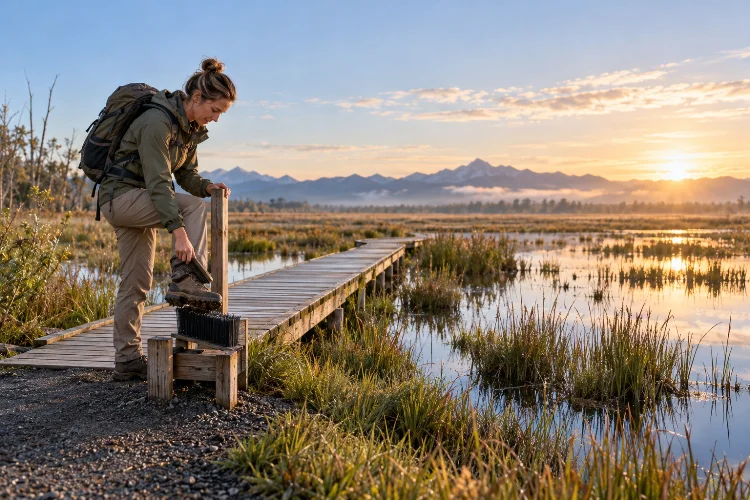
Clean footwear before entering the next ecosystem rather than assuming a small amount of soil is harmless. Inspect Velcro, cuffs, gaiters, and pack straps where seeds can hide.
For aquatic recreation, the U.S. Fish & Wildlife Service promotes the Clean, Drain, Dry approach: remove visible organisms and mud, drain water-holding equipment, and allow gear to dry before using it in another waterbody.
Biosecurity is easy to overlook because the impact is often invisible, but prevention can be far easier than controlling an invasion later.
4. Plan Wildlife Viewing From a Distance
Sensitive ecosystems are often valuable precisely because they provide breeding, feeding, or resting habitat.
That means visitors should think about how routes interact with wildlife movement.
Do not position yourself between animals and water, nests, young, feeding areas, or obvious travel corridors. Use binoculars, spotting scopes, or longer camera lenses instead of moving closer.
National Park Service guidance emphasizes that if an animal reacts to your presence, you are already too close. Some parks also establish specific minimum viewing distances depending on the species.
San Juan Island National Historical Park, for example, uses larger recommended distances for seals and sea lions than for many terrestrial species.
The most ethical wildlife encounter is usually one where the animal continues feeding, resting, or moving normally.
5. Use Seasonal Timing to Reduce Disturbance
Where you travel matters, but when you travel can be equally important.
Nesting, breeding, migration, spawning, and winter survival create periods when animals may be particularly sensitive to disturbance.
Wildlife refuges sometimes close specific trails or habitats during these periods. Alamosa National Wildlife Refuge, for example, implemented seasonal trail restrictions during nesting season to reduce conflicts between visitors and an endangered bird species.
Before finalizing your itinerary, check official alerts and management pages.
If a sensitive habitat becomes heavily used during a particular month, travelling during a less vulnerable season may reduce your impact while also creating a quieter experience.
Seasonal planning can also help avoid overcrowding. Fewer visitors often means less trail erosion, less noise, and lower cumulative pressure on wildlife.
Conservation-minded travel works best when your schedule can accomodate the needs of the ecosystem rather than forcing the ecosystem to accommodate yours.
6. Keep Camps Small and Away From Sensitive Areas
Camping concentrates human activity into a relatively small space.
Tents compress vegetation, repeated walking creates trails, food attracts animals, and water access can become heavily disturbed.
Leave No Trace recommends established or already impacted campsites in high-use areas and advises protecting water sources by camping well away from lakes and streams where local regulations allow.
Avoid enlarging campsites unnecessarily.
Keep tents, cooking areas, and gear on durable surfaces rather than spreading across surrounding vegetation. Large groups should use sites designed for their size when those are available.
Sensitive riparian zones deserve particular attention because animals often rely on the same access routes humans use to reach water.
A slightly less scenic campsite can sometimes create a substantially smaller ecological footprint.
7. Manage Waste According to the Specific Ecosystem
“Leave no trace” does not always mean using the exact same waste technique everywhere.
Soil depth, decomposition rates, water tables, visitor density, and local regulations all influence appropriate disposal methods.
Great Basin National Park, for example, advises visitors to pack out trash and toilet paper and provides specific guidelines for human waste placement away from water, campsites, and trails.
Other fragile environments may require human waste to be packed out entirely.
Research these rules before departure rather than improvising once you are already in the backcountry.
Food scraps deserve the same treatment. Apple cores, nut shells, and other biodegradable-looking waste can still alter animal behavior or introduce seeds.
Everything brought into a sensitive enviroment should have a clear exit plan.
8. Avoid Turning One Visit Into a New Trail
Photography and wildlife watching create a common conservation problem: social trails.
One person leaves the main route for a better angle. Another sees the footprints and follows. Eventually, an unofficial path develops through vegetation that was never designed to tolerate repeated traffic.
The same pattern happens around waterfalls, cliff viewpoints, beaches, wildflower fields, and wildlife observation spots.
Leave No Trace explains that repeated off-trail travel can create visible routes that encourage even more people to follow them.
Before stepping away from an established trail, ask whether your route is legal, necessary, and durable enough to handle use.
If accessing a viewpoint requires trampling flowers, climbing over restoration barriers, or crossing closed habitat, the photograph is not worth the damage.
Good conservation travel sometimes means accepting a less perfect view.
9. Reduce Resource Use Beyond the Trail
Your ecological footprint starts before reaching the protected area.
Transport, accommodation, water use, food choices, and local spending can all influence how sustainable a trip becomes.
Where practical, stay longer in one destination instead of making repeated short trips, use shared or public transport when available, and choose local operators that follow conservation rules rather than offering access to restricted wildlife or habitats.
Ask how tour operators manage waste, group size, wildlife distance, and community benefits.
Smaller groups are often easier to manage in fragile terrain because they generate less noise and concentrated trampling.
Supporting locally based guides can also improve your understanding of seasonal restrictions and culturally important areas that may not be obvious from a generic travel guide.
Conservation travel is partly about where money and attention go, not just what happens on the trail.
10. Leave Natural Objects Where They Belong
Shells, rocks, flowers, driftwood, feathers, and other natural objects may look like harmless souvenirs.
Removing them repeatedly can still change an ecosystem.
Natural materials can provide shelter, nutrients, nesting material, or habitat structure. Collecting wildlife parts may also be restricted by law depending on species and location.
Great Basin National Park’s Leave No Trace guidance specifically asks visitors to leave natural and cultural objects where they find them.
Photography is usually a better souvenir.
The same principle applies to rearranging landscapes for photographs. Avoid stacking rocks, moving vegetation, relocating animals, or altering tide pools to create cleaner compositions.
A sensitive ecosystem should look almost exactly the same after you leave.
11. Support Conservation Beyond the Visit
Responsible travel does not have to end at the trailhead.
Many parks, refuges, and conservation organizations run volunteer programs involving habitat restoration, invasive-species removal, monitoring, or education.
The U.S. Fish & Wildlife Service encourages visitors to participate in local projects and report suspected invasive species through appropriate agencies.
Even small actions can help.
Pay required entrance or permit fees, support legitimate conservation organizations, follow local guidance, and report damaged infrastructure or invasive organisms when requested.
Avoid posting precise locations of rare plants, nests, dens, or vulnerable species online when doing so could attract damaging visitor pressure.
Responsible sharing is an increasingly important part of conservation travel.
The responsability is not simply to enjoy wild places, but to avoid making them harder to protect.
Sensitive ecosystems require a different style of travel. The goal is not simply to leave less trash, but to reduce the full footprint created by movement, camping, wildlife viewing, equipment, timing, and even online sharing.
Effective advanced conservation travel strategies for sensitive ecosystems start with researching seasonal restrictions, using durable surfaces, cleaning gear, respecting wildlife distance, managing waste carefully, and supporting local conservation efforts.
Before your next nature trip, learn what makes the destination vulnerable and adjust your itinerary accordingly. Stay on appropriate routes, respect closures, clean equipment between ecosystems, and choose experiences that do not depend on disturbing wildlife or fragile habitat.
The best conservation traveler is not invisible – but the ecological evidence of their visit should be as close to invisible as possible.