
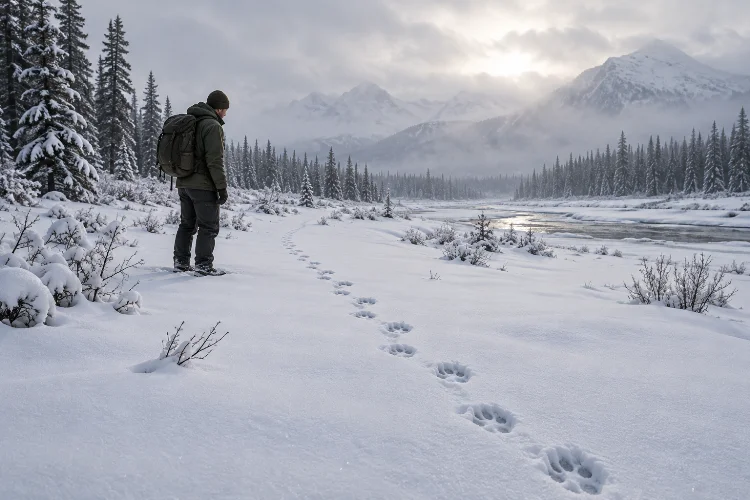
Animal tracking is partly about knowing wildlife, but it is equally about understanding the ground beneath your feet. A perfect paw print can disappear after ten minutes of heavy rain, while a fresh layer of snow can reveal an entire night of movement that would normally remain invisible.
That is why understanding how weather conditions influence animal tracking opportunities can dramatically improve your time in the field.
Temperature, precipitation, wind, humidity, and changing ground conditions affect both the signs animals leave behind and when wildlife is likely to move.
The U.S. Fish & Wildlife Service describes fresh snow as an excellent surface for revealing the movements of animals that might otherwise remain unseen. Tracks can provide clues about gait, habits, size, and behavior.
Instead of treating bad weather as something that automatically ruins a tracking trip, experienced observers learn which conditions create useful evidence – and which ones erase it.
1. Fresh Snow Creates a Natural Tracking Surface
Few weather events change animal tracking as dramatically as fresh snowfall.
A clean layer of snow effectively resets the landscape. Old tracks disappear beneath the new surface, which means prints found soon afterward are generally much easier to place within a recent time window.
The National Park Service describes snow as an excellent surface for reading animal stories. Track patterns can reveal how animals move, including walking, hopping, pacing, and bounding.
Fresh snow can also expose routes used by animals that are rarely seen directly. Foxes, rabbits, squirrels, otters, coyotes, and small rodents may leave obvious trackways connecting feeding and resting areas.
However, snow quality matters. Deep powder can distort prints, while melting or refreezing may enlarge their edges and make identification harder.
2. Temperature Changes How Snow Tracks Look
Finding a footprint in snow does not mean you are seeing the animal’s foot at its exact size.
Temperature changes the surface after the track is created. Sunlight and warmer air can soften edges, while refreezing may harden distorted impressions.
The National Park Service notes that identifying tracks can become difficult depending on snow type, track age, temperature, and conditions since the prints were made.
This is why measuring only one footprint can produce misleading conclusions.
Study several prints and examine the full gait pattern instead. A repeated pattern usually provides more reliable information than the apparent dimensions of one melted track.
Whenever possible, note whether temperatures have risen or fallen since the tracks were likely created. That context helps explain why footprints may look larger or less detailed than expected.
3. Rain Can Both Reveal and Erase Evidence
Rain is one of the most complicated conditions for trackers.
Light or moderate rainfall can create excellent tracking surfaces by softening dry soil and producing fresh mud around trails, water sources, and streambanks. Animals moving afterward may leave sharp impressions.
Heavy rain does the opposite.
It can quickly soften the edges of prints, wash away scat, flatten vegetation, and remove subtle signs entirely. Once rainfall becomes intense, determining whether a track was made before or after the storm can become difficult.
The best opportunity often comes shortly after rainfall stops.
Check muddy trail edges, creek banks, road margins, and other surfaces where animals commonly move. A recent shower can act almost like a reset button, making newer tracks easier to seperate from older ones.
Avoid damaging the same soft surfaces yourself. Walk beside promising track areas where possible so your footprints do not destroy the evidence.
4. Hot Weather Changes When Animals Move
Weather affects more than tracks – it changes animal behavior itself.
In hot environments, many mammals reduce activity during the middle of the day. Canyonlands National Park explains that numerous desert animals are nocturnal or crepuscular, with dawn and dusk offering cooler conditions than midday.
U.S. Fish & Wildlife Service guidance similarly notes that wildlife at many refuges becomes easier to observe around dawn and dusk, while fewer animals may be moving during hot summer afternoons.
For trackers, this influences where fresh signs are likely to appear.
An early morning search around water sources or travel corridors may reveal tracks created during overnight activity. By midday, those prints may already have been disturbed by heat, wind, insects, or human traffic.
In hot regions, tracking shortly after sunrise can therefore be more productive than simply spending more hours outside.
5. Wind Can Destroy Fine Details Quickly
Wind is easy to overlook because it leaves no obvious water behind, but it can dramatically affect track preservation.
Fine sand and loose snow are particularly vulnerable. Wind can fill shallow depressions, soften edges, or completely bury smaller tracks.
White Sands National Park notes that tracks in dune environments can be short-lived, even though the sand provides excellent evidence of nocturnal animals when conditions are right.
In snowy areas, wind may create another interesting effect: surrounding snow can blow away while compacted snow inside a footprint remains, leaving a raised track rather than a depression.
When conditions are windy, prioritize sheltered areas such as forest edges, depressions, protected banks, and the lee side of terrain features.
These places may preserve signs long after exposed tracks have vanished.
6. Weather Determines Which Substrates Are Most Useful
Trackers should think about surfaces as much as species.
Snow is excellent in winter. Mud becomes productive after rain. Fine sand records footprints in dry regions, while dusty paths can preserve surprisingly clear signs during calm weather.
The National Park Service showcases animal tracks preserved across snow, mud, and sand, illustrating how different substrates record wildlife movement.
Weather determines which surface is useful on a particular day.
After prolonged dry conditions, hard soil may record almost nothing. One rainfall event can transform the same location into an excellent tracking site.
Instead of searching every part of the landscape equally, ask which surfaces recent weather has improved.
That simple change in approach can save hours of unproductive searching.
7. Seasonal Weather Changes Animal Activity Patterns
Individual storms matter, but broader seasonal conditions can be even more important.
Winter snow may reveal mammals that remain difficult to observe directly. At Trempealeau National Wildlife Refuge, for example, winter visitors can find fox and coyote tracks, mouse tunnels, and otter slides recorded in snow.
Other species may reduce activity during cold conditions, migrate, hibernate, or shift their daily routines.
The same is true during summer. Desert reptiles may change from daytime activity during milder months to more crepuscular schedules during intense heat.
Tracking plans should therefore consider both immediate weather and seasonal ecology.
Seeing fewer tracks does not automatically mean fewer animals live in the area. They may simply be moving less, using different habitat, or travelling at another time of day.
8. Use Weather Events to Estimate Track Freshness Carefully
Recent weather can act as a useful timeline.
If heavy rain ended at midnight and you find an undamaged print the following morning, the animal probably passed through after the rain. A fresh snowfall can provide a similar reference point.
This is one of the most useful ways weather helps estimate track age.
However, avoid becoming overly precise.
Shade, sunlight, wind, temperature, substrate, and protection from vegetation can cause nearby prints to age at very different rates. A track under tree cover may remain sharp while one only a few meters away deteriorates quickly.
Use terms such as fresh, recent, or weathered rather than claiming an exact age unless the evidence genuinely supports it.
Track aging is an interpretation, not a stopwatch.
9. Poor Weather Can Improve Tracking but Increase Human Risk
The best tracking conditions are not automatically the safest conditions for people.
Fresh snowfall may produce spectacular tracks while also hiding trails, covering ice, and increasing exposure risk. The National Park Service warns that winter trail and weather conditions can change quickly as snow falls or melts.
Rain can create mud while simultaneously raising rivers or increasing hypothermia risk. Extreme heat may concentrate animal activity around cooler periods while making long field sessions dangerous for trackers.
Do not let an interesting trail of footprints override basic field safety.
Check forecasts, carry appropriate clothing, maintain navigation awareness, and establish a turnaround point.
There will always be another track. Weather-related risks to the observer deserve the same attention as the evidence being studied.
10. Avoid Following Fresh Tracks Too Aggressively
Weather can make fresh tracks unusually easy to follow, especially after snow or rain.
That does not mean every trail should be pursued until the animal appears.
Fresh signs may lead toward resting areas, feeding sites, dens, young animals, or wildlife already stressed by difficult conditions. Winter animals in particular may need to conserve energy rather than repeatedly moving away from curious visitors.
If tracks become increasingly fresh, slow down and consider studying them backward instead of continuing in the animal’s direction.
Use the evidence to understand gait, route choice, and habitat without forcing a direct encounter.
Wildlife observation guidance consistently recommends watching animals from a distance and using tracks and other signs as alternatives to approaching them.
A good tracker does not need every trail to end with a sighting.
11. Keep Weather Notes With Your Tracking Records
Weather records make a field journal much more useful.
Alongside species guesses and track measurements, record recent rainfall or snowfall, temperature, wind, cloud cover, substrate moisture, and approximate time.
Over multiple trips, those notes can reveal patterns.
You may discover that a muddy creek bank produces excellent prints after light overnight rain, or that tracks on an exposed dune disappear rapidly once afternoon wind develops.
Recording conditions also improves identification. If a print looks unusually large, knowing that snow temperatures rose substantially during the day may explain the distortion.
Small observations accumulate into practical field knowledge.
Instead of relying only on a track guide, you begin learning how signs behave in the specific enviroment you visit.
Weather constantly rewrites the evidence animals leave behind. Snow can reveal entire movement patterns, rain can create fresh muddy surfaces, wind can erase tracks, and temperature can change both print quality and wildlife activity.
Understanding how weather conditions influence animal tracking opportunities allows you to choose better times, surfaces, and locations for field observation. It also helps you judge freshness more realistically instead of interpreting every clear print as recent.
Before your next tracking trip, check what the weather has done during the previous day – not only what it will do while you are outside.
Look for surfaces recently improved by rain or snow, adjust your timing to animal activity, and observe fresh signs without pursuing wildlife. Learning to read weather and tracks together makes the landscape far more informative.