
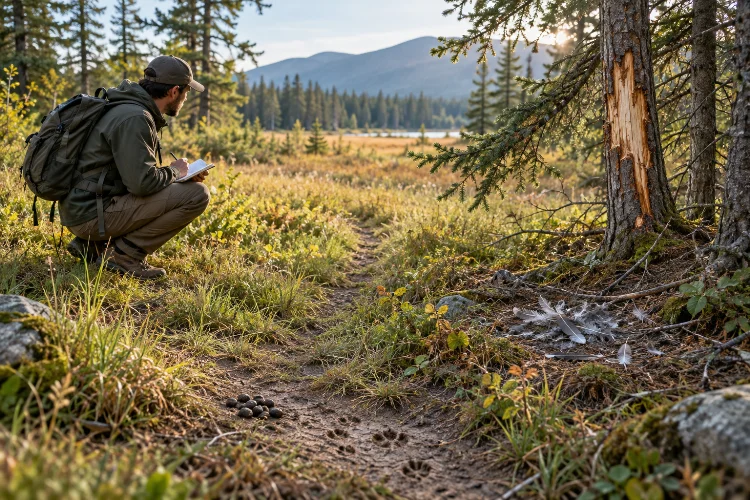
You do not need to see an animal to know it has been nearby. A line of footprints across mud, bark stripped from a tree, a pile of feathers beneath a branch, or a narrow trail through grass can reveal more about wildlife activity than a brief sighting ever could.
That idea sits at the heart of advanced field signs for identifying wildlife without disturbance. Instead of actively pursuing animals, skilled observers learn to interpret the evidence wildlife naturally leaves behind.
The National Park Service encourages visitors to look for tracks, scat, nests, nibbled vegetation, burrows, and other signs when wildlife itself remains hidden.
This approach is especially useful for nocturnal, shy, or well-camouflaged species. More importantly, it allows travelers to understand animal behavior while keeping their distance.
Good field observation is therefore less about finding wildlife at any cost and more about learning how to read the landscape carefully enough that the landscape tells you what is living there.
1. Start With Tracks, but Look Beyond Footprint Shape
Footprints are often the most recognizable wildlife sign, but identifcation should not depend on a single perfect print.
Look at toe arrangement, heel-pad shape, claw marks, overall width, and the relationship between front and rear feet. Then step back and examine the entire trackway.
The pattern can reveal whether an animal was walking, hopping, running, or moving slowly through an area. Tracks in sand, mud, dust, and snow can preserve different levels of detail, so the substrate should always be considered before judging size.
White Sands National Park notes that tracks can reveal the activity of animals that are rarely seen directly, particularly nocturnal species active when visitors are absent.
A slightly imperfect sequence of several prints can therefore be more informative than one unusually clear footprint.
2. Read Scat as Context, Not as a Standalone Answer
Scat can reveal the presence of animals long after they have moved elsewhere.
Its size, shape, location, and visible contents may help narrow down possible species. Seeds, plant fibers, fur, insect remains, or bone fragments can also provide clues about diet.
But scat identification should be approached cautiously.
Different animals can produce surprisingly similar droppings, and diet can change appearance considerably. Use scat alongside tracks, habitat, feeding signs, and other evidence rather than treating it as proof by itself.
The National Park Service includes droppings among the common signs that can reveal otherwise hidden wildlife.
Avoid touching or breaking scat apart with bare hands. Photograph it where it lies and leave it undisturbed.
Besides reducing potential exposure to pathogens, this preserves evidence for other observers and researchers.
3. Study Feeding Marks on Plants and Trees
Wildlife often leaves signatures on its food.
Browsed twigs, stripped bark, gnawed wood, scratched trunks, opened nuts, damaged fruit, and chewed leaves can indicate which animals have been feeding nearby.
Different feeding styles leave different patterns.
Beavers, for example, create distinctive gnawing marks on trees and can leave felled trunks, tracks, and other evidence around waterways. The National Park Service specifically highlights gnawed stumps and felled trees as useful beaver signs.
Look at the height of the damage as well.
Vegetation browsed close to the ground suggests a different animal than bark or branches damaged well above knee height. Combining feeding height with nearby tracks can significantly improve identification.
Freshness matters too. Bright exposed wood or moist plant tissue may indicate relatively recent activity, while weathered surfaces usually suggest the sign has been there longer.
4. Recognize Nests, Burrows, Dens, and Resting Sites
Wildlife modifies habitat in ways that can remain visible even when the animal is absent.
Nests, burrows, dens, beds in vegetation, webs, tree cavities, and excavated soil can all provide useful evidence.
Saguaro National Park lists burrows, holes, nests, webs, footprints, scat, and damaged vegetation among the signs visitors can use to detect hidden wildlife.
The challenge is observing these features without turning curiosity into disturbance.
Never reach into a burrow or approach an active nest closely to confirm what is inside. Avoid standing directly beside den entrances or blocking obvious travel routes.
Ethical wildlife guidance from the National Park Service specifically advises visitors not to stand near dens and not to constrain animal movement.
Sometimes identifying a site only as “likely mammal burrow” is better than getting closer for a definitive answer.
5. Look for Hair, Feathers, Pellets, and Other Small Clues
Some of the best field signs are easy to walk past.
Hair may become caught on rough bark, fences, or narrow passages. Feathers can indicate roosting, molting, feeding, or predation. Owl pellets beneath a regular roost can contain bones and other prey remains.
National Park Service interpretation guidance recommends looking beneath trees for pellets when searching for evidence of owls.
Location gives these small signs meaning.
A single feather in an open field may tell you very little. Multiple feathers concentrated beneath a perch, combined with pellets or whitewash, create a stronger pattern.
Avoid collecting feathers or wildlife remains. Apart from possible legal restrictions, removing evidence changes the site.
Photographs, dimensions, notes, and context are usually more valuable for field learning than carrying the object home.
6. Follow Wildlife Trails With Your Eyes, Not Your Feet
Animals often create narrow paths through vegetation.
Repeated movement between water, feeding areas, cover, and resting sites gradually forms game trails that can reveal how wildlife uses the landscape.
Look for compressed vegetation, repeated footprints, mud marks, hair, scat, or branches worn smooth at body height.
The important ethical distinction is that recognizing a wildlife trail does not mean you should follow it indefinitely.
A trail may lead directly toward a den, nesting area, bedding location, or young animals. Following fresh signs too aggressively can turn passive observation into pursuit.
Instead, study the trail from an established path or durable surface. Consider its direction and what habitat features it connects.
Fieldcraft improves when you learn to interpret movement without needing to discover where every trail ends.
7. Add Sounds to Your Field-Sign Toolkit
Wildlife leaves acoustic evidence too.
Bird calls, alarm notes, woodpecker drumming, frog calls, insects, rustling vegetation, and territorial sounds can reveal animals that remain visually hidden.
Saguaro National Park specifically encourages visitors to listen for bird songs and insect sounds when searching for signs of animal life.
Listening becomes especially useful in dense vegetation.
Rather than pushing through undergrowth toward a sound, stop and determine its direction. Repeated calls may reveal whether an animal is moving or remaining in one location.
Learn common calls before visiting a destination, but avoid overusing recorded sounds to attract wildlife.
Artificial calls can interrupt territorial, feeding, or breeding behavior. The National Park Service prohibits using devices to call wildlife in some managed areas and emphasizes avoiding intentional disturbance.
8. Combine Multiple Signs Before Identifying a Species
Advanced field identification is essentially evidence building.
One footprint may suggest a species. Tracks plus scat increase confidence. Add habitat, feeding marks, gait, and seasonal knowledge, and the picture becomes considerably stronger.
Suppose you find medium-sized tracks beside a stream. Nearby are gnawed branches and a well-used route entering the water.
Those clues together provide much stronger evidence than the footprint alone.
Avoid forcing signs to match the animal you hoped to find.
Misidentification often happens when observers decide what species they want the evidence to represent and then ignore contradictory clues.
Write down several possibilities when evidence is incomplete.
Uncertainty is not a weakness in wildlife observation. It is often the most accurate conclusion available.
9. Use Habitat and Time of Day as Supporting Evidence
Every wildlife sign exists within a larger ecological context.
A track found beside a wetland should be interpreted differently from an identical-looking mark on a dry mountain ridge. Elevation, vegetation, nearby water, food sources, season, and time of day all help narrow down realistic possibilities.
Sequoia and Kings Canyon National Parks recommend learning both habitat preferences and the times when different species are active. They also suggest searching for tracks and scat as part of wildlife observation.
Habitat edges can be especially useful.
Forest-meadow boundaries, riverbanks, wetland margins, and transitions between open and covered terrain often concentrate wildlife movement.
Instead of wandering randomly through sensitive habitat, observe promising transition zones from established trails.
This increases the chance of finding evidence while reducing your impact on the enviroment.
10. Estimate How Fresh a Sign Really Is
Knowing that an animal passed through is useful. Estimating when it occured can be even more informative.
Fresh tracks in soft mud often have sharper edges. Wind, rain, falling leaves, drying, and other animal traffic gradually change them.
Fresh feeding marks may expose bright wood or moist plant tissue. Older scat often becomes dry, faded, or broken down.
However, aging signs is difficult because local conditions can preserve or degrade evidence at very different speeds.
A print protected beneath trees may remain sharp much longer than one exposed to wind and rain.
Avoid making precise statements such as “this track is exactly two hours old” unless you have very specific evidence.
Relative terms – fresh, recent, weathered, old – are usually more realistic.
11. Know When Field Signs Mean You Should Leave
Some wildlife evidence should make you more cautious rather than more excited.
Fresh large-predator tracks, active dens, animals with young, carcasses, or concentrated feeding signs may indicate that wildlife is close.
Continuing forward simply to obtain a sighting can increase risk for both people and animals.
The National Park Service advises giving wildlife enough room to move and states that if an animal reacts to your presence, you are already too close. Many parks establish minimum viewing distances, although exact requirements vary by location.
Use binoculars or telephoto lenses instead of approaching.
If signs suggest sensitive breeding, nesting, feeding, or resting activity, changing direction may be the best field decision.
The purpose of reading signs is not always to get closer. Sometimes they tell you exactly where not to go.
12. Record Signs Without Changing Them
A field notebook can dramatically improve wildlife identification skills.
Record the habitat, date, weather, approximate location, track measurements, direction of movement, nearby scat, feeding signs, and your confidence level.
Photograph tracks from directly above when possible and include a scale without disturbing the print.
Record different clues seperately before deciding which species produced them. This reduces the tendency to interpret every new sign according to your first assumption.
Ethical observation also means leaving evidence where you find it.
Stay on established trails whenever possible, because unnecessary off-trail movement can damage habitat and disturb animals. NPS guidance notes that remaining on trails helps keep human activity predictable while protecting wildlife and surrounding ecosystems.
The ideal field observer leaves with better knowledge but almost no physical evidence of having been there.
Wildlife identification becomes much more interesting when you stop depending entirely on direct sightings. Tracks, scat, feeding marks, nests, burrows, hair, feathers, sounds, trails, and habitat clues can reveal how animals move and live even when they remain hidden.
Using advanced field signs for identifying wildlife without disturbance means combining multiple pieces of evidence while respecting the space animals need to behave naturally.
On your next nature trip, slow down and study what is already around you. Photograph signs instead of collecting them, stay away from active dens and nests, and use binoculars when wildlife appears.
The better you become at reading subtle evidence, the less you need to pursue animals – and the more natural behavior you can understand.