
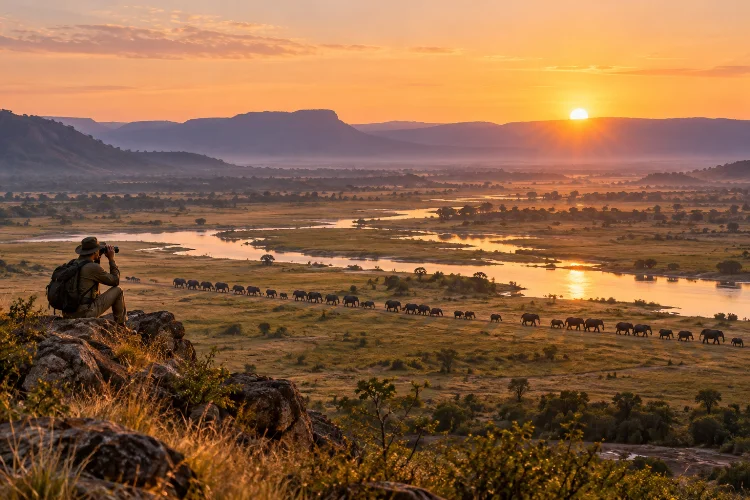
Wildlife travel can involve a surprising amount of luck. You can visit an incredible national park and spend hours seeing very little, while another traveler arrives a month later and watches hundreds of animals moving through the same landscape.
The difference is often timing.
Animals rarely use every part of their habitat equally throughout the year. They move between feeding grounds, breeding areas, water sources, winter ranges, nesting sites, and seasonal habitats. Many species also follow predictable daily activity cycles.
Understanding how animal movement patterns improve wildlife travel planning helps travelers choose better destinations, seasons, times of day, and observation locations without chasing animals through sensitive habitat.
The U.S. Geological Survey explains that many mammals, birds, fish, bats, insects, reptiles, and other species migrate between habitats to find food, reproduce, and raise young. These journeys often follow established migration corridors.
Instead of asking only, “Where does this animal live?”, wildlife travelers should ask, “Where is it likely to be right now?”
1. Think in Seasonal Ranges, Not Permanent Locations
A species appearing on a park wildlife list does not guarantee it will be easy to see during every month.
Many animals occupy different seasonal ranges. Large mammals may move from lower wintering areas toward higher summer habitat, while migratory birds can appear in enormous numbers for only a relatively short period.
The U.S. Fish and Wildlife Service notes that wildlife behavior varies substantially with season and that spring and fall migration periods can be especially productive for watching birds.
This changes how a wildlife trip should be planned.
Before choosing accommodation or trails, research when the target species actually uses the region. A location famous for elk, cranes, or waterfowl may feel remarkably quiet if your trip falls outside its major seasonal window.
Timing the season correctly can matter more than adding another day to the itinerary.
2. Use Migration Corridors to Understand Where Animals Travel
Wildlife does not always move randomly between seasonal areas.
Many species use recognizable corridors connecting feeding grounds, breeding habitats, resting areas, and seasonal ranges.
The U.S. Fish and Wildlife Service describes wildlife corridors as routes that allow birds, mammals, fish, and other species to move between habitats needed throughout their life cycles.
For wildlife travelers, corridors provide useful context.
A broad valley connecting winter and summer habitat, for example, may offer better observation opportunities during migration than an otherwise attractive viewpoint far from the movement route.
Modern GPS tracking has made these patterns easier for scientists to understand. USGS researchers use location data to map migration corridors, stopover sites, and high-use seasonal areas.
Travelers should use publicly available migration information responsibly. The purpose is to understand general movement patterns, not to locate individual animals or enter restricted habitat.
3. Match Your Schedule to Daily Activity Cycles
Season is only half the timing equation.
Many animals change their activity throughout the day. Temperature, predators, feeding behavior, and human disturbance can influence when wildlife moves.
The U.S. Fish and Wildlife Service notes that early morning and early evening often provide stronger viewing opportunities because many animals become more active around dawn and dusk.
That makes daily itinerary design surprisingly important.
Instead of hiking to a wildlife-rich wetland at midday, consider arriving near sunrise and saving less time-sensitive activities for the afternoon. A second observation period before sunset can further increase your chances.
This does not apply equally to every species, of course. Some wildlife is primarily nocturnal, while other animals remain active throughout daylight.
Research the target species rather than assuming dawn is always best.
4. Look for Habitat Edges and Transition Zones
Movement often becomes easier to observe where two habitats meet.
Forest edges, wetland boundaries, riverbanks, lake margins, and transitions between grassland and woodland can concentrate wildlife because animals may find feeding, water, and shelter close together.
The U.S. Fish and Wildlife Service recommends watching transition zones such as forest-to-field and field-to-river boundaries, noting that these places often support considerable wildlife diversity.
These areas can improve travel planning because you do not need to wander constantly in search of animals.
Choose an established observation point overlooking several habitat types and wait quietly.
Patience can be far more productive than walking continuously through the landscape. It also reduces disturbance, particularly around feeding or resting locations.
A good wildlife itinerary should include time to sit rather than treating every hour as distance to cover.
5. Connect Movement With Food and Water
Animals move for reasons, and two of the strongest are food and water.
Seasonal vegetation, fruiting trees, flowering plants, insect emergence, fish runs, and changing water availability can all influence where wildlife concentrates.
Large herbivores may follow improving vegetation as seasons change. Migratory birds use stopover habitat where they can rest and replenish energy, while predators may appear in areas where prey becomes temporarily abundant.
USGS migration research shows that environmental variables such as vegetation green-up, snow conditions, elevation, and landscape characteristics can help explain movement corridors used by migrating ungulates.
Travel planning becomes more sophisticated when you connect these ecological clues.
Rather than simply looking for “deer habitat,” ask where fresh vegetation is likely to occur during your visit. Instead of searching an entire wetland for birds, identify shallow feeding areas or productive habitat edges.
The idea is to predict movement rather than chase it.
6. Understand How Weather Changes Movement
Weather can alter animal activity quickly.
Hot conditions may reduce daytime movement as animals conserve energy, while cooler mornings or evenings can produce more visible activity. Rain, snow, wind, drought, and seasonal storms may also influence feeding or migration.
The U.S. Fish and Wildlife Service notes that wildlife viewing can become much quieter during hot summer afternoons, while dawn and dusk may remain productive periods.
Longer-term environmental changes matter too.
The National Park Service explains that migration timing and routes can respond to seasonal ecological cues such as rainfall and vegetation growth, while drought, wildfire, and changing climate conditions may shift movement patterns.
This means historical advice should be treated as guidance rather than a guarantee.
Check recent refuge reports, ranger updates, water conditions, snowpack, and unusual weather before finalizing your wildlife itinerary.
7. Treat Stopover Areas as Important as Destinations
Migrating animals do not necessarily travel continuously from one seasonal range to another.
Many pause at stopover sites where they feed, rest, or wait for suitable conditions. For wildlife watchers, these temporary concentration points can sometimes offer more interesting observations than the final destination.
USGS movement research identifies both corridors and areas where animals spend more time during seasonal movements, helping scientists distinguish travel pathways from important high-use areas.
Bird migration offers an obvious example.
A wetland located along a major flyway may receive waves of different species over several weeks, even though many of those birds neither breed nor spend the winter there.
Planning around stopover ecology therefore opens more options.
You do not always need to travel to a famous breeding site. Sometimes the best viewing happens halfway along the journey.
8. Build Flexibility Into Wildlife Itineraries
Wildlife does not follow tourism schedules.
Even when seasonal patterns are well understood, animals can arrive early, leave late, change elevation, or shift feeding areas due to weather and habitat conditions.
Avoid building an itinerary around one exact location and one narrow observation period.
Instead, choose several suitable habitats within the same region. If your first wetland is quiet, you might try another valley or observation area rather than spending the entire day searching increasingly hard for one species.
This flexibility also reduces the temptation to approach animals too closely when sightings are disappointing.
Movement science can improve probabilities, but wildlife travel should always preserve some uncertainty.
That unpredictability is part of what makes real wildlife observation different from visiting a zoo.
9. Plan Around Movement Without Blocking It
Understanding movement patterns creates an ethical responsibility.
Migration corridors, water sources, feeding grounds, den areas, and crossings may concentrate wildlife, but visitors should avoid positioning themselves where animals have to choose between approaching humans or abandoning the route.
The National Park Service advises that if wildlife changes its behavior because of your presence – moving away, approaching, becoming agitated, or stopping normal activity – you are too close.
Observation points should therefore sit beside movement corridors rather than directly inside them.
Use binoculars, spotting scopes, or long lenses. Stay on established trails where required and keep movements predictable.
Knowing where animals travel should make you less intrusive, not more succesful at getting physically close.
10. Protect Sensitive Seasonal Behavior
Some periods require more caution than others.
Breeding, nesting, raising young, migration, and winter survival can place significant demands on wildlife. Repeated disturbance during these periods may cause animals to waste energy or leave valuable habitat.
This is why temporary closures and seasonal access restrictions sometimes appear around nesting areas, migration routes, or other sensitive sites.
Respect them even when the restricted area seems empty.
Animals may be difficult to see precisely because they are resting, nesting, moving at night, or using cover.
Responsible wildlife travel is based on observing natural behavior rather than producing a sighting at any cost.
A missed photograph is temporary. Disturbing a breeding animal or blocking a migration path can have much greater consequences.
11. Use Movement Knowledge to Photograph More Ethically
Wildlife photography often becomes easier when you understand where animals are already likely to travel.
Instead of approaching an animal, position yourself at a legal and safe distance near a known observation area and let wildlife movement create the opportunity.
Shenandoah National Park recommends watching quietly from a distance and using binoculars, spotting scopes, zoom lenses, or telephoto lenses rather than attempting to get physically closer.
This technique usually creates more natural images too.
An animal walking normally through its habitat tells a more interesting story than one staring nervously at the photographer.
Study movement direction, remain still, and allow the scene to develop.
If the animal changes direction because of you, step back rather than repositioning to block it again.
12. Keep Notes and Refine Future Trips
Animal movement knowledge becomes more useful when you build your own observation record.
Record the date, time, weather, habitat, approximate location, species, group size, and general movement direction. Avoid publicly documenting precise locations of sensitive nests, dens, or threatened species.
Over several trips, patterns may begin to appear.
You might discover that a particular wetland becomes active shortly after sunrise or that animals regularly use a meadow during cooler evenings.
Compare these observations with official seasonal information rather than assuming one encounter represents a permanent pattern.
Wildlife conditions change, but a thoughtful field record can improve future trip planing considerably.
Understanding animal movement turns wildlife travel from random searching into informed observation. Seasonal migration, daily activity cycles, habitat corridors, food availability, water, weather, and stopover areas all help explain when and where animals are likely to appear.
Learning how animal movement patterns improve wildlife travel planning also encourages more ethical behavior. Instead of chasing individual animals, travelers can choose promising habitats, wait quietly, and observe movement from an appropriate distance.
Before your next wildlife trip, research seasonal ranges and migration timing, plan outings around suitable activity periods, and identify several observation locations.
Then remain flexible once you arrive. Wildlife will never follow a perfect itinerary, but understanding why animals move can dramatically improve your chances of being in the right place without getting in their way.