
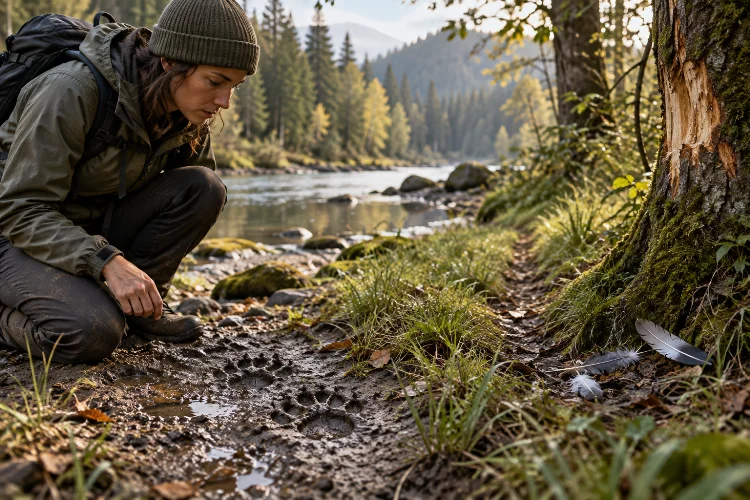
Seeing a wild animal is exciting, but experienced nature travelers know that the most interesting clues often appear long before the animal itself.
A footprint pressed into soft mud, freshly gnawed bark, a trail through grass, feathers beneath a tree, or scat beside a game path can reveal surprisingly detailed stories about what happened hours earlier.
That is where advanced wildlife tracking techniques for ethical nature travel become valuable. Tracking is not simply about following footprints until an animal appears.
It involves interpreting movement, habitat, feeding signs, seasonal behavior, substrate, and environmental conditions while minimizing your own impact.
The National Park Service encourages visitors to look for signs such as tracks and scat while observing wildlife from a distance rather than approaching animals directly.
Ethical tracking adds another important principle: the goal is understanding wildlife without forcing animals to change their behavior. When tracking is done well, you can learn more while actually disturbing wildlife less.
1. Read the Entire Trackway, Not Just One Footprint
Beginners often focus on finding the clearest individual footprint. Advanced trackers look at the pattern created by many prints.
The spacing between tracks, direction of travel, stride length, and position of front and rear feet can reveal how an animal was moving. Walking, running, bounding, hopping, and stalking can produce very different track patterns.
National Park Service interpretation materials note that track patterns can show how an animal moves. Foxes, for example, may place their rear feet into or close to the tracks made by their front feet, while rabbits and similar animals produce characteristic hopping patterns.
Look beyond perfect prints. Even when individual tracks are unclear, several disturbances in snow, sand, or mud may form a recognizable movement pattern.
This wider perspective often tells you more than one beautiful footprint ever could.
2. Consider Substrate Before Judging Track Size
Footprints are not exact molds of an animal’s feet.
Soft mud can make tracks appear wider than they really are. Powdery snow may collapse around a print, while hard soil may preserve only claws or the deepest parts of a foot.
This is why identification based purely on dimensions can be misleading.
Compare several prints rather than measuring just one. Look at toe arrangement, heel shape, claw marks, symmetry, track width, and the relationship between individual prints.
Environmental conditions matter too. A track that looks fresh because it has sharp edges may actually be older if it was protected from wind and sunlight.
Good wildlife tracking involves building an argument from several clues rather than forcing the first footprint to match a species you hope to see.
3. Use Gait Patterns to Understand Animal Behavior
Tracks can sometimes tell you not only which animal passed through an area but what it was doing.
Longer strides may indicate faster movement. A suddenly irregular trackway could suggest that an animal stopped, turned, investigated something, or changed speed.
Tracks moving repeatedly between trees might indicate feeding behavior. A straight, efficient line across open terrain may suggest purposeful travel between habitat zones.
NPS educational material demonstrates how different trackway patterns can reveal whether animals are hopping, pacing, or moving with rear feet following front prints.
This is where tracking becomes much more interesting than simple identification.
Instead of saying, “A fox was here,” you might begin asking, “Why did it slow down here?” or “Why does this trail suddenly turn toward the vegetation?”
Those questions help reconstruct behavior without needing to approach the animal itself.
4. Combine Tracks With Scat and Feeding Signs
Wildlife rarely leaves only one kind of evidence.
Scat, feathers, fur, scratched soil, chewed vegetation, gnawed wood, burrows, nests, and feeding remains can help confirm what tracks suggest.
Saguaro National Park, for example, encourages visitors to look for footprints, scat, burrows, nests, webs, and damaged or nibbled vegetation as indicators of wildlife activity.
The U.S. Fish and Wildlife Service similarly recommends watching for tracks, missing bark, burrows, feathers, and scat when searching for evidence of animals.
Avoid touching scat, carcasses, feathers, nests, or other biological material unnecessarily. Apart from disturbance, animal waste and remains may carry parasites or disease.
Photograph clues where they are instead of collecting them. Leaving signs undisturbed also allows other visitors and researchers to interpret the same enviroment.
5. Learn Where Tracks Are Most Likely to Survive
Tracking becomes much easier once you stop searching everywhere equally.
Some surfaces preserve evidence far better than others. Mud near water, soft sand, snow, dusty trails, exposed streambanks, and fine sediment can record footprints clearly.
Natural movement corridors are especially productive.
Animals frequently use washes, shorelines, trail intersections, narrow valleys, forest edges, and transitions between feeding and shelter areas. Saguaro National Park notes that desert washes can function as travel corridors where tracks and scat are particularly noticeable.
Rather than wandering through vegetation searching randomly, identify these likely travel zones and observe them carefully.
This approach is both more efficient and more ethical because it reduces unnecessary off-trail movement through sensitive habitat.
6. Use Habitat to Narrow Down Possibilities
A footprint should always be interpreted in the context of where you found it.
Habitat can dramatically reduce the number of realistic species possibilities. Tracks beside wetlands suggest a different group of animals than prints found high on a dry ridge.
Vegetation, food sources, elevation, proximity to water, shelter, and season all provide context.
The U.S. Fish and Wildlife Service recommends learning seasonal wildlife patterns because migration and activity vary throughout the year. Winter, for example, can make animal tracks particularly visible in snow even when wildlife itself remains difficult to see.
Think like an ecologist rather than simply matching shapes in a field guide.
Ask what the animal would gain from being in that location. Is there water nearby? Food? Cover? A travel corridor?
Combining habitat and physical signs can make identification considerably more reliable.
7. Track Backward Instead of Chasing Fresh Signs
Finding extremely fresh tracks can be exciting, but following them directly toward an animal is often poor ethical practice.
Fresh tracks may lead toward feeding areas, resting sites, dens, nests, or young animals. Continuing forward can cause wildlife to flee or abandon important behavior.
Leave No Trace specifically recommends observing wildlife from a distance and avoiding animals during sensitive periods such as mating, nesting, raising young, and winter.
An excellent alternative is backtracking.
Instead of following signs toward where the animal went, move in the opposite direction and reconstruct where it came from. You can still study gait, route choice, habitat use, and feeding behavior without increasing the chance of disturbing the animal.
Sometimes the most advanced tracking decision is knowing when not to follow.
8. Use Time of Day and Season Strategically
Wildlife activity follows patterns.
Many species are more active around dawn, dusk, or nighttime, while others respond strongly to temperature and season.
Sequoia and Kings Canyon National Parks recommend learning when different animals are active and note that dawn and dusk can be productive periods for wildlife observation.
The goal, however, should not be to corner animals during active periods.
Use timing to interpret evidence. Tracks appearing overnight in fresh snow, for example, may provide an unusually clean record of activity without requiring you to encounter the animal.
Rain can also reset tracking surfaces by erasing older prints. Visiting muddy trails after rainfall may therefore make newer tracks easier to distinguish.
Understanding timing helps you read signs more accurately while relying less on direct pursuit.
9. Watch the Animal’s Response to Your Presence
If tracking eventually leads to a wildlife sighting, switch from tracking mode to observation mode.
Do not keep advancing simply because the animal has finally appeared.
The National Park Service states that if wildlife reacts to your presence, you are too close. Many parks require minimum distances of around 25 yards from most wildlife and considerably more from animals such as bears or wolves, although exact regulations vary by location.
Use binoculars, spotting scopes, or long lenses rather than walking closer.
Behavior is often the best warning sign. An animal that stops feeding, repeatedly watches you, moves away, changes direction, gives alarm calls, or positions itself defensively may already be responding to your presence.
Ethical observation aims to watch natural behavior – not behavior caused by the observer.
10. Never Bait, Call, or Manipulate Wildlife for a Better Sighting
Wildlife tracking should reveal what animals naturally do.
Baiting or deliberately calling animals changes that relationship.
San Juan Island National Historical Park specifically prohibits feeding, baiting, intentionally disturbing wildlife, and using devices to call animals. It also advises visitors not to stand near dens or create barriers that interfere with animal movement.
Avoid leaving food, scents, or objects intended to attract animals.
Similarly, do not move branches around a nest, alter tracks to make photographs clearer, or position yourself so an animal must pass close to you.
The most valuable observations are usually those where the animal never needed to acknowledge your presence.
11. Protect Sensitive Wildlife Locations
Modern tracking often includes photography, mapping apps, GPS coordinates, and social media.
These tools can be useful, but location data can also increase pressure on sensitive wildlife sites.
Be careful when sharing the exact locations of nests, dens, roosts, rare species, breeding areas, or other vulnerable habitats. A single public location can eventually attract many visitors.
Instead, record observations for your own learning or submit them through appropriate conservation or citizen-science channels when suitable.
Avoid creating informal trails toward repeatedly used wildlife locations. San Juan Island National Historical Park advises visitors to remain on designated trails and avoid creating new social trails that can disturb habitat.
Ethical tracking should increase knowledge without increasing traffic around the animals being studied.
12. Keep a Wildlife Tracking Journal
Memory becomes surprisingly unreliable after several days of field observation.
A simple journal can turn casual tracking into a much stronger learning process.
Record the date, habitat, weather, approximate location, substrate, track dimensions, direction of movement, gait pattern, associated scat or feeding signs, and your confidence in the identification.
Take photographs with a familiar object or scale beside the track when appropriate, without damaging it.
Over time, patterns begin to appear. You may notice that certain animals repeatedly use the same habitat transitions or that particular surfaces preserve useful tracks after certain weather conditions.
The important part is remaining comfortable with uncertainty. Writing “possibly fox” is better than confidently recording the wrong species.
Good trackers are not people who always have an answer. They are people who know how much evidence supports the answer they have.
Wildlife tracking can transform a nature trip from simply searching for animals into learning how they move through an entire landscape. Tracks, gait patterns, scat, feeding signs, habitat, weather, and seasonal activity all contribute pieces to the story.
The best advanced wildlife tracking techniques for ethical nature travel also recognize clear limits. Observe wildlife from a distance, avoid following fresh signs into sensitive areas, never bait animals, and protect the locations of nests, dens, and vulnerable species.
On your next nature trip, slow down and look for the evidence animals leave behind rather than rushing toward the next sighting. The more carefully you learn to read those clues, the more wildlife you can understand – often without the animal ever knowing you were there.